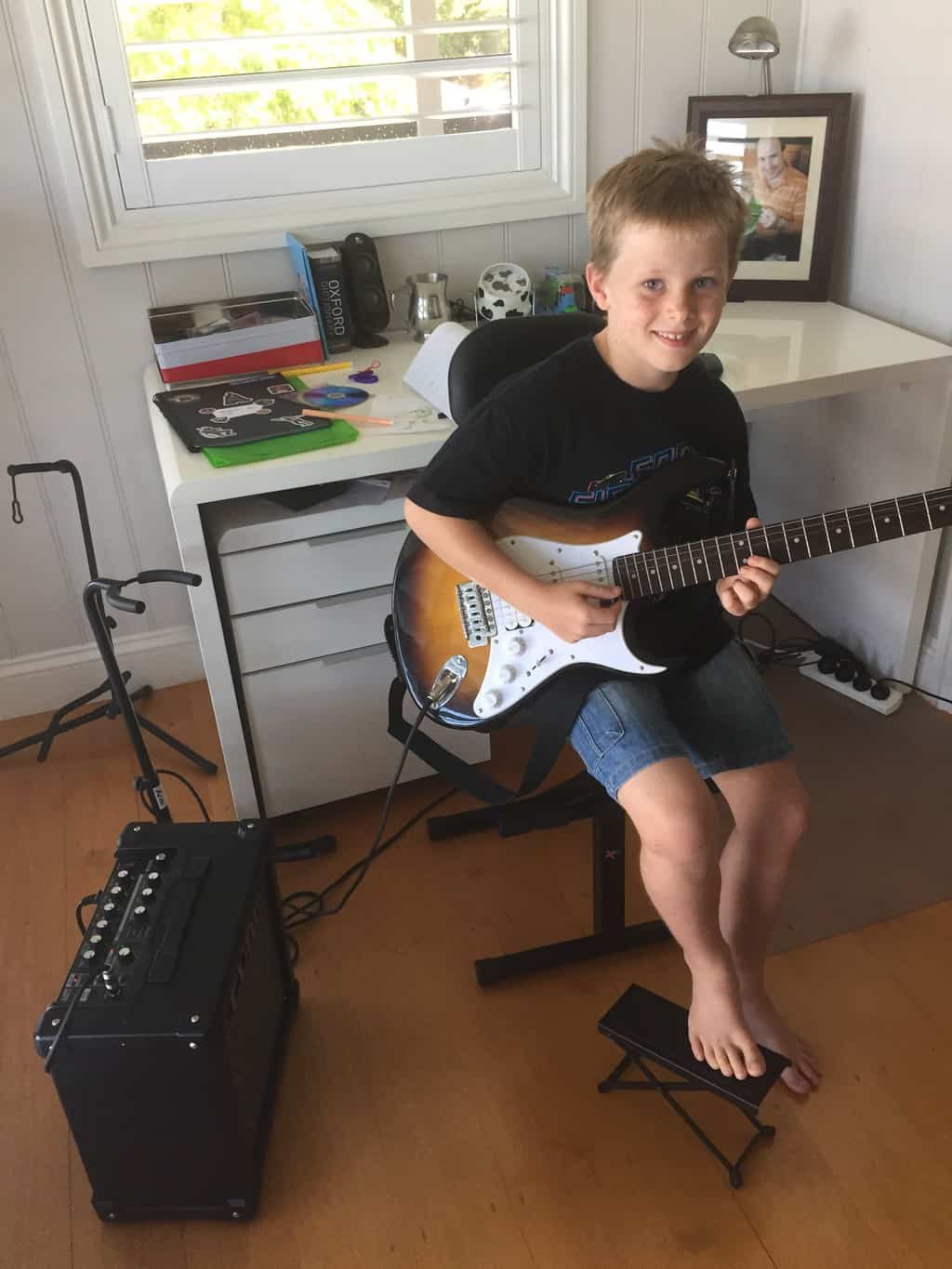
May 2015, Ashgrove: Ian Coulton

Ian Coulton
Ian Coulton

Axe(s): Yamaha Pacifica 012, Bolero g703 (nylon string)

Amp and Effects: Ibanez IBZ10G with Overdrive effect

Favourite Styles: Jazz, Blues, Post-punk, Shoegaze, all sorts of lo-fi stuff, Pop-punk, Alternative rock, Post-rock.

Influences: Bossanova music, Blues music, indie music. Bands/Artists like Beck, Jeff Magnum, Iceage, Andrew Jackson Jihad and Cap’n Jazz come to mind as influences when playing nothing in particular in my spare time.

Favourite Quote: “It’s good enough for Jazz” – Lucas (guitar coach) on guitar tuning

Career Highlights: Playing on stage at the Christmas concert/showcase last year (2014) and freaking out internally. Despite almost completely freezing up and not playing to the best of my ability on stage with the two other performers, after the fact everybody was very friendly.  On top of being one of the nervous experiences I’ve had, it was also one of the most exciting, satisfying and relieving experiences I’ve ever had.

What do you love about The Guitar Gym?:  Everybody involved from fellow students in the waiting room to the guitar instructors are really friendly and like-minded.  That in the space of a single lesson your learning can be driven forward in many different directions in such a free form manner. From starting to learn a song to then getting help on a technique to grasping concepts of music theory.  A lot of this I’ve found to be due to the fact that the coaches are very open to ideas and queries that I’ve had during a lesson and are able to pick these up, interpret them and run with it.  It’s that aspect I believe that has helped me so far with becoming comfortable and confident learning the guitar and approaching new ideas.  I also love taking lessons with a partner, it has opened up a wide variety of learning experiences and makes the lesson quite dynamic.

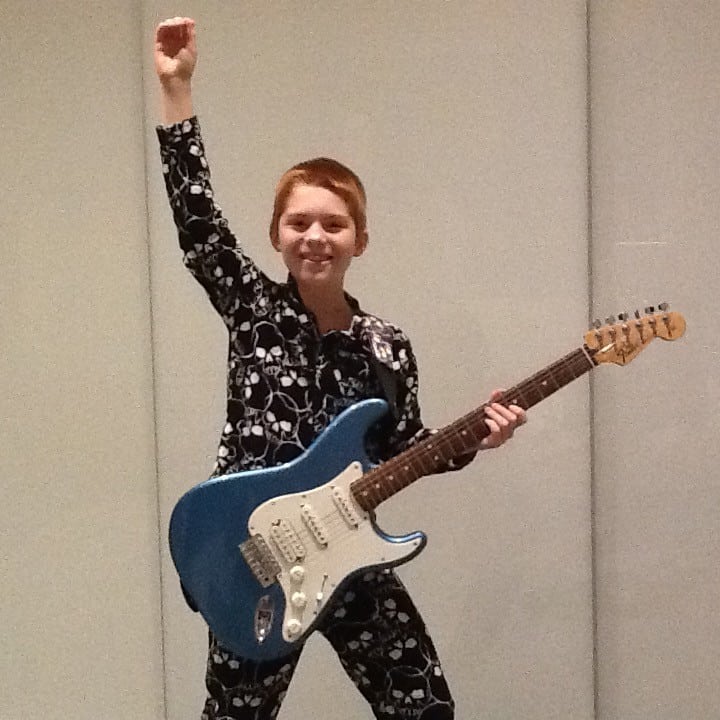
May 2015, Indooroopilly: Will Caton

Will
“Guitar Rocks!” – Will

 Axe(s):  Acoustic and electric

 Amp and Effects:  crunch, echo, OD 2

 Favourite Styles:  Hard rock, harmonic, pop and country.

 Influences:  Ed Sheran, ACDC, Red Hot Chilly Peppers, Eagles, my teacher Dan.

 Favourite Quote:  “Guitar rocks!”

 Career Highlights:  The Guitar Gym chord challenge and playing in the end of    year concert.

 What do you love about The Guitar Gym?  What I love about the guitar gym   is that my teacher Dan makes learning the guitar fun by playing games and making us laugh.

April 2015, Ashgrove: Max Lian

Max Lian, The Guitar Gym AshgroAxe(s): There’s a few! My Squier Affinity J Bass gets a lot of love. I also have a Fender Blacktop Strat, and a Travel Guitar Speedster.

Amp and Effects: VOX VT20+ and Fender Rumble 40. I also have a little Roland Cube that’s very portable.

Favourite Styles: I’m into most anything except hip-hop, rap, and death metal.

Influences: It’s no secret that I love Melissa Etheridge’s music. I’m also a big fan of The Doobie Brothers, Creed, The Eagles, Indigo Girls, Collective Soul, Gary Moore, Jamiroquai, John Mellencamp, Lenny Kravitz, Meshell Ndegéocello.. I could go on and on. Is it OK to admit I like Nickelback? Don’t hate me!

Favourite Quote: “To accomplish great things, we must not only act, but also dream; not only plan, but also believe” – Anatole France

Career Highlights: I can’t say there are any highlights. I just enjoy being in the moment!

What do you love about The Guitar Gym? I like that the teachers are so easy-going, and that they don’t heap pressure on me to practice if I don’t feel like it. I’m never going to be a rock star, and I don’t want to be. I just want to have fun playing music! My teachers help me play the songs I want to play without making it a chore. Classes are always light-hearted and fun.

April 2015, Indooroopilly: Morgan Jury

member of the month April 2015, The G

member of the month April 2015, The GAxe(s):  Cort Electric

Amp and Effects:  Roland Cube 20GX

Favourite Styles: Rock, Grunge

Influences:  Foo Fighters, Nirvana, 

Favourite Quote:  Be awesome!

Career Highlights:  Being able to play all of Everlong like Dave Grohl and practicing to play at my school fete.

What do you love about The Guitar Gym?  My teacher is nice and they give good options of the songs to play.

Bearing With Barre Chords

Bearing With Barre Chords

Why they are worth the effort!

Barre chords are most likely the single most intimidating technique for learner guitar players. They present a challenge in many ways: They are physically demanding due to the need to hold down five or six strings at once with the index finger, they involve learning a number of new chord shapes, they involve moving up the fretboard (which can be a big step for those used to only open chords) and they require a certain level of fretboard note knowledge to use effectively. The learning curve involved with their use has created a culture of fear surrounding them, causing students to shy away from them without giving them a reasonable attempt. Barre chords are absolutely worth the amount of effort required to become functional in their use, and this article will demonstrate why.

barre chords

A suitable challenge

Firstly, the fact that they are difficult to learn is no reason not to learn them. Chances are learning open chords was a challenge when you first started learning to play the guitar. Playing barre chords hurts your hand at first – chances are so did playing on the guitar for the first couple of weeks. Barre chords, just like any chords when you first started playing, will hurt less and less the more you use them. As they become more comfortable physically, you will also find that the sound generated on the barred strings will improve as the tension across the fretboard becomes more consistent. Barre chords are one of the most challenging techniques on a guitar – once you can handle these, nothing else will ever appear challenging again.

It should also be noted that the biggest step you can take in making barre chords easier is checking your thumb position. You will get far better tension across the fingerboard if your thumb is in the middle of the back of the neck, pointing upwards at approximately a 90-degree angle to the neck. If your thumb is reaching over the top of the neck, then you will find it substantially harder to get even tension in your barre chords.

Allows chords that can’t be played in open position and eliminates the need for a capo

There is a limit to the number of chords that can be played easily and pleasantly in open position. There are a number of chords that simply do not fit well in open position – the B chord, for instance. Barre chords allow you to play any major, minor or dominant chord regardless of whether or not open strings can be included in the voicing. B, Bb, F#m and Eb are all chords that are used commonly in songs, but can’t be played in any reasonable voicing in open position. When using a barre chord, it is as simple as finding the root note and applying the relevant chord shape.

This is another advantage afforded by barre chords. Once the shapes are mastered, they can be applied to any root note. Whatever key you are playing in, you can play the appropriate chords for that key without worrying about finding some obscure open chord shape for it. This also means that capos are no longer strictly necessary to play songs in their original keys. Ultimate Guitar has a convenient “transpose” tool on its chord charts. Simply transpose up to the number at which the capo would have been to reveal the “real” chords, then use your barre chord knowledge to play them as barre chords, negating the need for a capo.

Allows versatility in chord voicings

Play a “C” chord. Play it again. It sounds the same, doesn’t it? Having the use of barre chords will allow you a great deal of diversity in your chord voicing. You could play a C barre chord with the root on the E-string, or a C barre chord with the root on the A-string. That’s two more ways to play the same chord. Try using a different one in different songs, or using different voicings in different parts of the same song. Being able to play chords in different places opens up a whole new dimension to learning songs, and allows you to make each song your own in a new way.

Allows quick cutoffs that are necessary for certain styles of music.

One of the challenging things that you may have found with barre chords is the difficulty involved in maintaining a chord that is held for any length of time. The ability for the whole chord to cut out at once when pressure is slightly lifted from the first finger is actually one of the barre chord’s greatest strengths. A number of styles of music rely on the barre chord’s ability to be played in a short and percussive fashion (or “staccato”) to create the desired effect in the rhythm guitar. Funk, Ska, Soul and Reggae come to mind immediately, but the use of staccato barre chords can be found in Rock, Jazz, Pop, Dance, and many other styles as well. Think of when the guitar enters about ten seconds into “Uptown Funk” by Mark Ronson feat. Bruno Mars. The tight, high-pitched chords can only be achieved by playing the Dm7 and G7 chords as barre chords at the tenth fret and stopping them as soon as the chord has sounded.

Facilitates better fretboard understanding

To make optimal use of barre chords, you need to have some level of understanding of where your notes are on at least the 2 lowest strings. It is fine if you don’t have this already before you start learning to play barre chords – learning barre chords will help you with your note positions on those two strings. The lowest note played in any given barre chord is the root of that chord – i.e. a C barre chord will have a C as the lowest note. To play a C barre chord, you would have to find a C note on either the low E or the A string. The same goes for any other barre chord. As you learn songs that incorporate them, going to certain barre chords will become more automatic, and those notes will become better internalised. Barre chords can also be modified in much the same way as your open chords – they can have extensions, suspensions, or any other modification you can think of. Because barre chords utilise the same shape for every key, you can use your barre chord shapes to better your understanding of how these modifications work.

Barre chords are ironic in a way. While they are one of the most difficult techniques to begin with, mastering their use effectively makes all future songs easier to play. The best advice that I can give when it comes to learning them is to not let the difficulty discourage you from pushing through with them. Even if you avoid them at home, working on them on a weekly basis in the focussed environment of a guitar lesson will cause you to gradually become better at them. Don’t be intimidated by how difficult they feel initially, and don’t be swayed by other people telling you how hard they are. Like any other skill, they just require a modicum of patience and perseverance. If you have already started learning barre chords and are finding them difficult, sticking to them is absolutely worth the effort. If you haven’t started on them, feel free to discuss it with your coach – they will be more than willing to show you how they work. Above all, don’t be distressed if you find them harder than you thought they’d be. Don’t expect to be able to do them first try. Any progress you make with the technique is good progress, no matter how slow it is. If you manage your expectations properly, then you won’t be stressed out by any rough patches that you may go through with this technique. Ultimately, they lead to a more fulfilling guitar experience, and more fun for you.


Psychology For Success: Understanding Cognitive Dissonance and How It Can Effect Your Guitar Playing

When a client of ours quits, we hold ourselves 100% responsible.  Why?  Because we have failed them.  They come to us for help.  They want to get better at guitar and achieve specific things with their instrument.  If they quit, we as their coach have obviously failed to provide adequate help and support where it really counts….in their head.  Nobody really needs us to teach them about music or how to play the guitar.  That information is freely or cheaply available everywhere.  (For more on this, please read our article “The Benefits of Having A Guitar Teacher”)

The battle is won or lost in the mind.  Succeeding at the guitar has nothing to do with natural talent (there is no such thing), having “musical bones” in your body, being too old, or having fat fingers.  Success is 100% dependant on developing a mindset that is conducive to improvement over the long term.  Key to such a mindset is having realistic expectations, both in terms of improvement and time devoted to one’s guitar practice.

Many people and especially adults we commence working with hold certain beliefs which are detrimental to succeeding with their guitar playing.  Many parents also hold beliefs that are to the detriment of their child’s guitar playing.  Largely these beliefs reflect “conventional wisdom”. There is so much total nonsense out there floating around that must have been perpetuated over the decades by archaic and obsolescent music teachers.  Amidst this sea of garbage, of most significance are beliefs about practice.

“I’m too busy to practice.”

This is by far the most common explanation provided by people when they quit.  But what are they really telling us here?

There are likely to be several things going on for the person, and none of them have anything to do with available time.  In these cases, while the person may genuinely believe they are too busy to practice, in reality they are not.  (And anyway, who said anyone had to practice?..more on this in Are You Really Too Busy To Play Learn Guitar?)

An understanding of the likely cognition (mental processing) that a person has undergone when they arrive at the decision to quit lessons citing this reason is essential in order for any music coach to become effective in their role.  Recognising the prevalence of the issue in question, effective communication with a client by an astute music coach in the early days of the working relationship will surely prevent the client from giving up unnecessarily.  What’s more, with an awareness of the cognitive processes at work in their own minds, the client will be in the best position to maximise their chances for success.  And after all, our job as guitar coaches is to ensure our clients succeed.

Cognitive Dissonance

In my early teaching days, I started to see the whole “I’m too busy to practice” issue was something that most people needed help with.  I recalled the term “Cognitive Dissonance” from my psychology studies at university.  I got out an old textbook and read up on it again, and started to think how this concept applied to my clients.

In psychology, cognitive dissonance is the excessive mental stress and discomfort experienced by an individual who:

  1. holds two or more contradictory beliefs, ideas, or values at the same time; or
  2. is confronted by new information that conflicts with existing beliefs, ideas, or values. This stress and discomfort may also arise within an individual who holds a belief and performs a contradictory action or reaction.

Leon Festinger’s theory of cognitive dissonance focuses on how humans strive for internal consistency. When inconsistency (dissonance) is experienced, individuals largely become psychologically distressed. His basic hypotheses are listed below:

The existence of dissonance, being psychologically uncomfortable, will motivate the person to try to reduce the dissonance and achieve consonance.  When dissonance is present, in addition to trying to reduce it, the person will actively avoid situations and information which would likely increase the dissonance.

Stress and discomfort may also arise within an individual who holds a belief and performs a contradictory action or reaction.

By applying Festinger’s theory we can start to explain the whole “I’m too busy to practice” scenario.

Let’s put this theory into some applicable equations!

In general:

Satisfaction = Perceived Reality – Expectation

If Satisfaction = 0 or >0

The person achieves as expected or better so cognitive consonance is achieved.  The person is happy/not stressed.

If Satisfaction = <0

The person fails to achieve expectation so there will be cognitive dissonance.  The person will be stressed and will take action to reduce the dissonance.


Specifically in terms of practice:

Satisfaction = Actual Practice Done – Self Imposed Practice Expectation

Example

Jimmy believes he needs to practice half an hour a day, 5 days a week, if learning guitar is going to be worthwhile.  Jimmy practices for half an hour only 2 times a week for 4 weeks.


Satisfaction = (2×30) – (5×30) = -(3×30)


Satisfaction is <0


Jimmy experiences cognitive dissonance as he is not meeting his practice expectations.  He is therefore stressed about guitar playing.  There is likely to be a lot of negative self-talk going on in his mind:

“I should be practicing more”

“I’m just lazy”

“Where is my self discipline?”

“I’ve had a terrible day at work, I just don’t feel like it.”

“Man, this is SO hard!”

“I’m just not getting anywhere”

Jimmy seeks to resolve his cognitive dissonance.  What are his options?


Look at the equation.

  1.  Jimmy could lower his expectations.

In fact, he could lower them to ZERO.  If expectations are ZERO, dissonance cannot occur.  Stress free!

  2.  Jimmy could increase his practice to meet his expectations.  

But if it was that easy, he’d be doing it anyway, right?  Well, there is a compounding problem here.  Jimmy isn’t meeting his practice expectations because he is AVOIDING practice.  He wants to practice more, but actively AVOIDS it!  Why?  Because he finds practice hard so it creates stress too!  And this is the key to why people don’t simply just do the practice they expect to do.  They will actively avoid playing because their actual ability does not meet their desired ability.  If it feels hard for Jimmy, and he feels as though he isn’t achieving, he’ll avoid it.  This is where the “I’m too busy” excuse comes in.  This is how people justify the avoidance behaviour.  People are never really too busy to practice, not for prolonged periods of time.  It’s just what they tell themselves because it seems a reasonable self-justification.  The constant prioritisation of all other things forms part of the avoidance behaviour.  Most adults have full time jobs, a family, children, etc.  But time in the day is there if you want it to be.  It may not be a whole and undisrupted 30 minutes, but you don’t necessarily need that!  In Jimmy’s case, practice in itself creates stress, which compounds the stress of not meeting his practice expectations.  Remember Festinger’s theory?  The person will actively avoid situations and information which would likely increase the dissonance.  So even though the dissonance created by practice (not meeting performance/playing expectation) is a separate equation to the dissonance created by not meeting practice expectation, it’s all stress for Jimmy!

  3.  Jimmy could quit guitar altogether.  

Sadly, for many people, this is the choice they take.  It’s the easy way out. Unfortunately, the stress is often replaced by regret, as they’ve given up on something they really wanted to do.

Cognitive Dissonance Is The Driver For Improvement

The irony is, that while cognitive dissonance leads to quitting for some people, it is the driver for improvement.

Let’s look at an equation again:

Satisfaction = Perceived Ability – Desired Ability

If Satisfaction = 0

The person reached their desired level of ability, so cognitive consonance is achieved and therefore there will not be any drive for further improvement.  Hence the term “raising the bar.”  Increasing desired ability further is necessary for continued improvement.

If Satisfaction = <0

The person has not yet reached their desired level of ability, so cognitive dissonance drives the person to improve further such that dissonance is resolved.  This is also why many high achievers are never satisfied and may struggle to be happy.

You may notice I have used the term “Perceived Ability” in the equation.  This is very important.  It is one’s own belief about their ability that is important.  As demonstrated by many contestants on American Idol, some people simply increase perceived ability by believing they are much better than they actually are in order to resolve their cognitive dissonance!  

Some Final Remarks

Of course, we generally advocate practising.  However, a practice program should be carefully developed through consultation between client and coach.  It must factor in the individual circumstances of the client and be achievable.  Start small.  Success breeds success.  Achieving the completion of a practice program will make you feel successful in itself.  Learn to identify negative self talk and understand what’s really happening in your head and why.  Recognise improvement, don’t dwell on practice.  Don’t lose sight of the big picture.  You have a fundamental desire to play guitar so don’t quit unnecessarily!

Getting the most out of your music with ACTIVE LISTENING

WHAT is Active Listening?

Music forms a kind of background to many of the activities that we undertake in our lives. Some of us listen to music while we study, some listen to it while we drive, some while we eat, some as we socialise. There is nothing wrong with enjoying music as part of doing another activity, but there is something to be said for what can be gained from listening to music AS an activity. By this I mean listening to music without looking at or doing anything else, with the music taking up all of your attention. In the past, this used to be the only way in which to observe music – before music could be recorded, the only way to experience it was in a concert hall or to make it yourself, and early gramophones required operation by hand, which suggests that you wouldn’t do it for the sake of background music. Even live music performed by popular artists often comes with an enormous visual aspect, including lights, dancers, pyrotechnics, costumes, etcetera. The shift of music’s role to “background music” isn’t a problem per se – film music, for instance, is meant to be background music. There is much that can be gained, however, from bringing music back into the foreground and listening to it, instead of just “hearing” it.


WHY should we Actively Listen?

More goes into a piece of music than just a melody or a chord progression. Sure, these are important parts of the song, but to judge a song based on only those factors is an incomplete assessment of what is contained in a recording. The song as written by the composer may contain more than these things already – even more can be achieved in the studio with the aid of the engineer. Orchestral works and songs with large bands will often have a number of things going on at any given time, even if many of those things are not fulfilling key roles in the ensemble.

It has been suggested that the decline in active music listening is part of the cause of the decline in general music literacy. Whether or not this is true, it can certainly be argued that many people don’t really understand what they are listening to – they just accept it as part of the world they live in, as part of the soundscape in their workplace, shops or car. Could they listen to the same music if they were alone in a room with a media player playing those songs and nothing else to entertain them? Does that music have the capacity to satisfy them in the same way when taken out of the distractive contexts in which it is normally heard?

Another suggested reason for the decline in active listening is the decrease in the popularity of instrumental music. Music that has no lyrics does not provide an easy way to relate to the song – there is no message or sentiment to  easily engage with by listening to the words. Instrumental music is not necessarily any less emotive than music with lyrics, but the music has to be actively listened to in order to best engage with the emotions in the work.

 [blockquote]There is much that can be gained, however, from bringing music back into the foreground and listening to it, instead of just “hearing” it.[/blockquote]

HOW do we Actively Listen?

The most important part of active listening is for the music to be the primary target of your focus. Don’t try to actively listen while doing anything else – don’t read, don’t play a game, don’t check your phone – the music has to have all of your focus. Watching the video clip for a song can also be highly distracting, unless the video clip only features footage of the artist playing the song. If it helps to close your eyes, by all means do so.

There are a number of things that you can keep an ear out for when you  are giving a song your full attention. A few of these will be discussed separately below. If you’re interested in addressing all of these aspects of the song, you will more than likely have to listen to the song more than once, focusing on different elements each time. Taking notes can be helpful, but it isn’t always entirely necessary.

It is worth keeping in mind that looking for every little thing mentioned here could be overly exhaustive. Music, like any art form in this post-modern era, ultimately means different things to different people and affects different people in different ways. The things that I find particularly interesting about a song might not be of any interest to you, and things that you find interesting may not occur to your neighbour, your co-workers, or the guy you walked past on the street the other day. All art is to some degree subjective, and music is no exception.


Structure

What sections are in the song? Does it follow a standard verse/chorus/verse/chorus/bridge/chorus form? Does it have many wildly varying sections? Do these sections repeat? Does the placement of each part in the song contribute in some way to the overall message or aesthetic of the song?

Are each of the verses different in any ways? Are they the same music with different lyrics? Is there a build up through the song – are later verses louder or more intense than earlier ones? Do some sections that have the same lyrics sound different? Why do they sound different? What instruments are playing differently, how does the playing differ, and what effect does it have on the sound?


Melody

Which instrument is playing the melody? The vocals will usually be taking the main melody, but that is not always the case. Is there more than one melody happening at the same time? Do these melodies interact in a way that sounds interesting? Is the melody a smooth melody where each note is close in pitch to the note before it, or is it jagged and angular, with big jumps between notes?

Is the melody repetitive? Do the repetitions vary from each other? Is the melody in the last chorus different to previous ones?


Bass

Is there a distinct bass line? A distinct bass line can not always be heard, especially if the bass is following the part played by the guitar. If there is a distinct bass line, what makes it distinct? Is it melodic? Is it sparse (only playing a couple of times a bar) or is it continuous/walking?


Chords/harmony

Does the song have an obvious chord progression? Is it the same few chords for the entire song? Is the chord sequence in the verse the same as in the chorus?

Is there any dissonance in the harmony of the song? Does it sound happy or sad, bright or dark?

Is the entire song consonant, or does it include notes or chords that sound jarring or unresolved? Is there ever a feeling of the song trying to lead somewhere harmonically, but the resolution being delayed?


Drums/percussion

Are there drums? Are they acoustic drums, or have they been synthesised? Is the same beat played for the whole song, or does it change for different parts of the structure? Which cymbals are used (hi-hat, crash, ride, splash, china, etc) and how does using these particular cymbals affect the texture of the song?


Other

Some things that can add to a recording of a song are not musical, or are at least unexplainable in musical terms. These can include sound effects (whether related to the lyrics or not), sounds from non-musical sources, or simply ways in which frequencies interact that defy explanation. Have you ever had part of a song make you think that your phone was ringing when it wasn’t, but there was no “ringing phone” sound in the song? You have subconsciously trained your ear to alert you where you hear your phone ringing, and the sounds in the song have interacted in a way that have excited those frequencies in your hearing. This particular reaction is just an example, of course. You could take this part as far as linking things that the song reminds you of – places, people, events. If it’s part of your reaction to the music, then it’s important to acknowledge.


Context

This is another point that is often neglected when considering the merits of a piece of music. The context can be considered at a macro level – which country it was composed/recorded in, what century/decade/year, what events were happening in the world, etc, or it can be considered at a more micro level – which album was it on, and how it reflects the overall aesthetic of that album, or how it differs from it. There is something to be said for listening to an entire album from start to finish – each song is its own creative unit, but the album can also be considered a creative unit of its own. Concept albums are an especially good example of this.


The goal of active listening isn’t to turn your music listening into study sessions. There is no reason not to continue listening to music the way that you always have. The next time you hear a song you like, however, take a moment to really listen. The reason you like it might not be the reason that you thought you did, or there may be more to the song that will make you like it even more. You might hear something that you’d never heard before, and will always notice in the future. However you look at it, actively listening to music will definitely help you to get more out of your day-to-day listening.

© The Guitar Gym Pty Ltd, 2015.  Except as provided by the Copyright Act 1968, no part of this publication may be reproduced in any form or by any means without the prior written permission of the publisher.  Links to this article are permitted.

2014 Performance Showcase Information

Everything you need to know about our upcoming Performance Showcase is here!

[accordion] [toggle title=”EVENT DETAILS” state=”closed”]

When
Saturday December 13, 2014.
Session 1:  Doors at 10:15am for a 10:30am start.
Session 2: Doors at 12:45pm for a 1:00pm start.

Where
The Judith Wright Centre For Contemporary Arts
420 Brunswick St (Cnr Berwick St)
Fortitude Valley

Parking
Find parking and transport information here .

[/toggle] [toggle title=”TICKETING INFORMATION“]
  • Tickets are available at the Judith Wright Centre’s website here , or by calling the box office on 07 3872 9000.
  • A ticket entitles you to attend either session or both sessions – you do not need to specify a session.
  • NOTE:  If you want a family ticket, put a 4 in the Enter # of tickets box when prompted, otherwise the family ticket option does not appear on the next page. If your family has 5 or more, you can enter as appropriate in the other boxes on the next page.
  • The venue requires all guests to have a ticket.  As performers form part of the audience when not on stage, they require a ticket.
  • If you have a child under 6, while admission is free, a complimentary ticket is required.  Please call the box office on 07 3872 9000.
[/toggle] [toggle title=”ON THE DAY“]

We appreciate your cooperation to help us make the event run as smoothly as possible on the day.  Please arrive on time for doors in the session you are playing. Guests, including performers, will not be permitted to enter the auditorium prior to doors.  We are busy until this time with set up and sound check.  Upon entering the performance space, performers are to place their instruments to the side of the stage as directed by staff and immediately find their seat in the audience.  If performers wish to warm up they should do so at home as there will be no opportunity for this on the day.  Vocalists are the exception and you will be advised of procedure by your coach.  Latecomers will only be admitted in between acts.  Please respect the instructions given by the ushers.

Performers will be called to the side of the stage a few acts in advance.  When called, please move promptly to the designated area, remain silent and follow directions given by staff.  Once your performance is finished, absorb your applause and immediately return to your seat in the audience.

A substantial and encouraging audience is critical to the performers’ positive experience at the event, so we do appreciate that you stay for the duration of the session and help create the atmosphere we strive for.  While we prefer that people stay for the duration of a session, we appreciate it is not always possible with small children who can become distressed.  If you choose to leave before the end of a session, please do so only between acts so as not to disturb the performance.

[/toggle] [toggle title=”GENERAL FAQs“]

Which session am I playing in?  You will receive a copy of the program around mid November and you will see which session you are in by referring to the program.

What time am I playing?  We cannot answer this question.  If you are in Session 1, you should arrive by 10:15am.  If you are in Session 2, you should arrive by 12:45pm.

Is it ok if I am late?  Please try to arrive on time for doors.  Admitting guests into the performance space during the show is disruptive and discourteous to performers.  You also risk missing your performance entirely.

What do I need to bring?  Guitarists:  Only your guitar.  Please ensure it is in tune.  Parents of young children with generic nylon string guitars please note that we normally arrange for enough identical guitars to be at the venue for use.  This saves us needing to tune a large number of instruments.  A staff member will be off stage to tune instruments for children.

Pianists:  Only your sheet music if you need it.  Better that you can perform a piece from memory though.

Can I bring my own amp and effects?  No.  Ensure you discuss effects needs with your teacher in your lessons.  There will be basic effects provided.

Are there rehearsals?  Yes, but only for those that need them.  Typically, rehearsals occur on the 2 weekends prior to the main event.  If a rehearsal is relevant to you, you will receive details at the earliest possible time.  Rehearsals are not charged for.

What is my child playing?  Please speak to the teacher.  In the months leading up to the concert we co-ordinate a spreadsheet of repertoire and who is playing what.  Until registrations close we cannot finalise the programme, however your child should have selected or been assigned a piece by the end of October.

[/toggle]

The Best Guitar For Beginners?

So you’ve decided to learn to play the guitar, that’s fantastic!  If you are in the market for a guitar to get started on you might be confused by the amount of choice. There are all kinds of shapes and sizes of guitars with different types of strings…..there are acoustic guitars, electric guitars, acoustic-electric guitars…..?

A question we receive all the time at The Guitar Gym is “what is the best guitar for beginners?”

Well let’s start by saying that your guitar doesn’t care how good you are!

The common advice which seems to be perpetuated by guitar teachers and sales assistants in guitar shops is that beginners should start playing on a nylon-string acoustic guitar, otherwise called a “classical guitar”.  We do not agree with this.  If you already have a nylon string guitar in working order there is no reason you can’t start with it, but it’s probably not the best choice unless you want to play classical guitar.

Here are the most common reasons you will hear as to why you should buy a nylon-string acoustic guitar as a beginner, and our refutations for each:

Reason #1.  Nylon string acoustic guitars can be purchased more cheaply than steel string and electric guitars.

Firstly, why are these people assuming you want to spend as little as possible?  Secondly, if you need a particular tool for a particular job, do you buy the wrong tool because it costs less? For example, if you need a drill, would you buy a saw because it is cheaper?  While fundamentally speaking a guitar is a guitar, and when you are first starting to play, the type of guitar you own will not dictate the content of your lessons too much, different guitars are designed for different applications.  You should purchase a guitar to suit the style of music you like and wish to play.

Reason #2.  Nylon strings are softer and do not hurt your finger tips as much as steel strings do.

Oh please, who cannot handle a bit of tenderness on their fingertips for a little while?  When you first start to play the guitar, the fingertips on your fretting hand will be soft which makes it very difficult to produce a good tone when fretting a note.  Why? Because when you push the string down, the string pushes back (Newton’s Third Law).  The tissue on the end of your finger is soft and spongy, so you have to push extra hard to compress the tissue to the point where “fret buzz” is eliminated even when fretting the note correctly, right in behind the fret.

You WANT to develop calluses on your fingertips as soon as possible, allowing notes to be cleanly fretted with a light touch.  It actually takes much longer to develop calluses playing on nylon strings than it does on steel strings.  The reality is that with consistent play, most people experience slight discomfort in their fingertips for only a week or so before their fingertips harden and they are away!

Reason #3.  The strings are spaced apart a little wider at both the nut and bridge, making it easier to form chords and pick individual strings.

While this is the soundest of the 3 reasons, there are pros and cons to wider string spacing.  A wider string spacing may make some chords such as the open position A chord easier to form, but others such as the common G chord (especially played in first position with fingers 2, 3 and 4) much more difficult.  Generally speaking, cheaper nylon-string guitars have thick neck profiles, which combined with the wide string spacing at the nut make them awful to play especially for those with small hands. Narrower string spacing generally requires a bit more precision for fretting chords cleanly, so it could be argued that it encourages better technique development.

Wider string spacing at the nut does make picking individual strings (string isolation) a little easier – this is why fingerstyle guitars are designed this way.  However, if you are playing with a plectrum, again it could be argued that a narrower string spacing encourages better technique as it requires more precision.

Here is our advice for buying your first guitar:

1.  Talk to us for some independent advice before buying your instrument.  We are always happy to help.

2.  Buy a guitar that suits the style and sound of the music YOU want to play.  For 99% of people, this is NOT a nylon-string guitar!  And by the way, there is nothing stopping you from starting with an electric guitar.  It is not a more advanced instrument that you must graduate to from an acoustic guitar as many people believe.

3.  Spend more if you can.  Some guitars do represent better value than others, but the market is competitive so in general if you spend more you should be buying a better guitar.  Cheap guitars are harder to play, lack tuning stability and intonation, and just don’t sound as nice.  Just because you are a beginner it doesn’t mean you won’t appreciate the feel and sound of a nice guitar!  The better you get, the more you will appreciate it too.

4.  Get a guitar you like the look and feel of.  If you have a vision of yourself rocking out onstage, what guitar are you playing?

5.  Avoid second hand instruments unless someone that knows their stuff has checked it out for you.  A lot can be wrong with a guitar that you might miss if you don’t know what to look for.

6.  If buying a steel string acoustic, avoid a “dreadnought body shape unless you are absolutely in love with it as they make playing with proper posture and neck angle while sitting down very difficult.  Try to find an auditorium or “OOO” body guitar instead.  For more information refer to our article Guitars Explained.

© The Guitar Gym Pty Ltd, 2013.  Except as provided by the Copyright Act 1968, no part of this publication may be reproduced in any form or by any means without the prior written permission of the publisher.  Links to this article are permitted.

Kick-Start Your Guitar Playing With 2 FREE Lessons !

X